

Your doctor ordered a complete blood count and now you’re looking at a printout full of abbreviations. MCHC blood test values, RDW numbers, MCH figures, all listed next to reference ranges you don’t know how to read. That’s a frustrating place to be, and it’s one we hear about often from patients.
The CBC is one of the most commonly ordered blood tests in medicine. It measures multiple types of blood cells across several distinct categories, and each category tells a different story about what’s happening inside your body. The challenge is that most result sheets don’t explain what those numbers actually mean in plain language.
At Daydream Health Lab, we bring you in-depth research, precise analysis, and actionable insights that help you make smarter health decisions. This guide walks through every major CBC component so you can read your results with clarity. For a full picture of the laboratory testing and diagnostics services we provide, that’s a good place to start.

How Do I Interpret My CBC Results?
A CBC result sheet lists values for red blood cells, white blood cells, hemoglobin, hematocrit, platelets, and several red cell indices. Each value has a reference range printed beside it. Values inside that range are typically normal; values outside it flag for review by your provider. Context always matters — a single out-of-range number rarely carries the same weight as a pattern of several related values pointing in the same direction.
The most useful approach is to read the CBC in groups rather than value by value. Red cell indices — MCHC, MCH, MCV, and RDW — all relate to the size, hemoglobin content, and variability of your red cells. Taken together, they help characterize the type of anemia present, if one exists. White cell counts break into subtypes: neutrophils, lymphocytes, monocytes, eosinophils, and basophils. Each subtype points toward a different category of immune activity. Platelets are evaluated for both count and, on some panels, average volume.
Our team of 20 expert staff at Daydream Health Lab has worked across 400+ completed diagnostic cases. What we see consistently is that patients benefit most when they understand not just whether a value is high or low, but why that matters for their specific clinical picture. Validated methods and calibrated instruments give us reliable data. Knowing how to interpret that data is what turns a result sheet into actionable guidance.
CBC Blood Test Normal Ranges
Reference ranges vary slightly between laboratories because of differences in equipment calibration and the populations used to set standards. The values below reflect widely published adult reference intervals. Always compare your results against the ranges printed on your own lab report, since those are specific to the instruments and methods your lab uses.
- Hemoglobin: 13.5–17.5 g/dL (men), 12.0–15.5 g/dL (women)
- Hematocrit: 41–53% (men), 36–46% (women)
- MCV (mean corpuscular volume): 80–100 fL
- MCH (mean corpuscular hemoglobin): 27–33 pg
- MCHC (mean corpuscular hemoglobin concentration): 31.5–35.7 g/dL
- RDW (red cell distribution width): 11.5–14.5%
- Platelets: 150,000–400,000 per microliter
- White blood cells (total): 4,500–11,000 per microliter
According to Mayo Clinic, a complete blood count is used to assess overall health and screen for a wide range of disorders, including anemia, infection, and leukemia. Even modest deviations from reference ranges can carry clinical significance when viewed alongside your history and symptoms.
“A complete blood count (CBC) is a blood test used to evaluate your overall health and detect a wide range of disorders, including anemia, infection and leukemia.”

What Are 5 Things the CBC Can Show Signs Of?
The CBC is a broad diagnostic tool. It doesn’t confirm diagnoses on its own, but its patterns reliably point toward categories of disease that warrant further workup. Five of the most clinically significant things it can signal include the following.
- Anemia: Low hemoglobin, hematocrit, or red cell count signals reduced oxygen-carrying capacity. MCV helps distinguish iron-deficiency anemia (low MCV) from B12 or folate deficiency (high MCV).
- Infection or immune response: Elevated white blood cells, particularly neutrophils, often accompany bacterial infection. Elevated lymphocytes can indicate viral illness or immune activation.
- Bone marrow disorders: Abnormal patterns across multiple cell lines, especially combinations of low red cells, white cells, and platelets, can suggest bone marrow suppression or myeloproliferative conditions.
- Bleeding or clotting problems: Low platelet counts increase bleeding risk. Very high counts can raise clotting risk in certain clinical contexts.
- Chronic disease: Mild anemia with a normal MCV is a common pattern in chronic kidney disease, inflammatory conditions, and some cancers — often described as anemia of chronic disease.
These are signals, not diagnoses. Our evidence-based approach at Daydream Health Lab is designed to identify which signals warrant follow-up testing and which fall within expected variation for a given patient, so that every result points somewhere useful.
“An elevated RDW can indicate that your red blood cells vary greatly in size, which can be a sign of nutritional deficiencies, certain chronic diseases, or bone marrow problems.”
Can a CBC Detect Inflammation?
A CBC can suggest the presence of inflammation, but it doesn’t measure inflammatory markers directly. Elevated white blood cells, particularly neutrophils, point toward active infection or acute inflammation. An elevated RDW has also been associated with systemic inflammation and chronic disease burden in research literature. For a direct inflammatory measure, a C-reactive protein (CRP) or erythrocyte sedimentation rate (ESR) test is typically ordered alongside the CBC.
In our work across our pathology testing and diagnostics services, we see the CBC most often serve as a first flag that prompts more targeted follow-up testing. A clinician reviewing elevated neutrophils and a mildly elevated RDW alongside a patient’s symptoms has useful preliminary data, even before a dedicated inflammation panel is run. That preliminary picture guides where to look next.
Studies indexed through PubMed (National Library of Medicine) have documented associations between RDW elevation and a range of inflammatory and chronic conditions, reinforcing the value of interpreting CBC results as part of a broader diagnostic picture rather than in isolation.
Understanding MCHC, MCH, and MCV in Your Results
These three red cell indices are the ones patients most often find confusing because the names are similar and the differences between them aren’t obvious from the abbreviations alone.
MCV (mean corpuscular volume) measures the average size of your red blood cells. Low MCV means cells are smaller than normal, which is typical in iron-deficiency anemia or thalassemia. High MCV means cells are larger, a pattern seen with B12 or folate deficiency and some liver conditions.
MCH (mean corpuscular hemoglobin) reflects the average amount of hemoglobin per red cell. It closely tracks with MCV, so low MCH usually accompanies low MCV. High MCH is less clinically significant on its own but tends to accompany the same conditions that raise MCV.
MCHC (mean corpuscular hemoglobin concentration) measures hemoglobin concentration relative to cell volume. A low MCHC value is called hypochromia and is characteristic of iron-deficiency anemia. A high MCHC is rarer and can indicate hereditary spherocytosis, a condition in which red cells are abnormally round and fragile.
Taken together, these three values help classify anemia into types, which directly guides treatment decisions. An MCHC blood test reading that’s low alongside a low MCV and low MCH points strongly toward iron deficiency. High MCV with normal MCHC points toward a different mechanism entirely. The pattern tells the story; the individual number only hints at it.
What About ALT, AST, and TSH — Are They on a CBC?
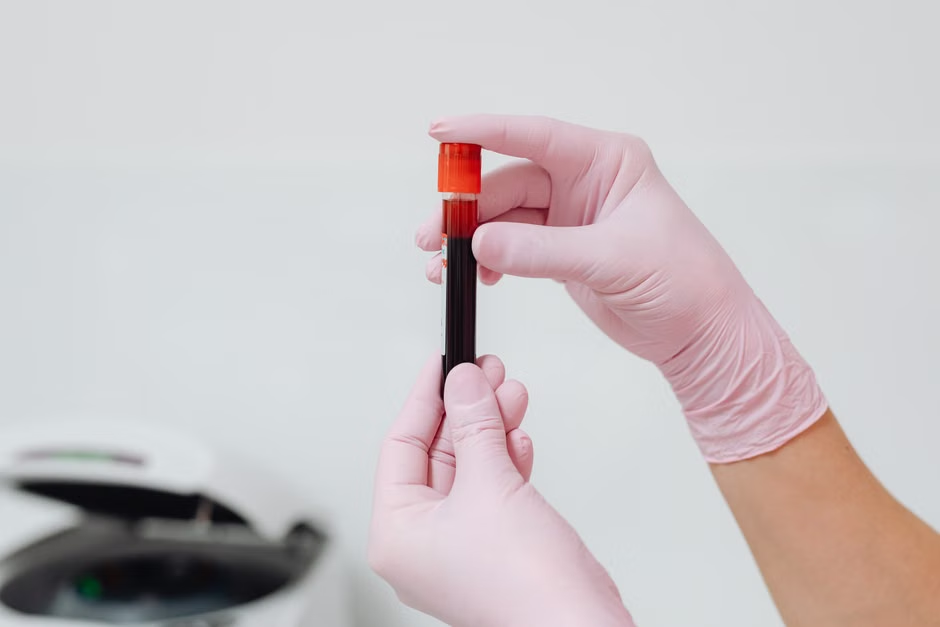
This question comes up often, and the short answer is no. An ALT blood test (alanine aminotransferase) and AST blood test (aspartate aminotransferase) are liver enzymes measured in a metabolic panel, not a CBC. They reflect liver cell activity and are used to screen for liver damage, hepatitis, and other hepatic conditions. A TSH blood test (thyroid-stimulating hormone) is a separate endocrine test that assesses thyroid function.
These tests are frequently ordered alongside a CBC because they add useful context. A patient with unexplained anemia might have ALT and AST ordered to rule out liver disease as a contributing factor. TSH testing is often added when fatigue is the presenting symptom, since hypothyroidism can produce anemia-like symptoms independently of actual red cell abnormalities. Blood types, similarly, are not part of a standard CBC and require a separate blood typing test.
Eric Obrien, blog contributor at Daydream Health Lab, notes that understanding which tests belong to which panels helps patients have more focused conversations with their providers, because each panel is measuring a completely different dimension of health.
Full Blood Count Interpretation: Putting the Picture Together
Reading a CBC is less about memorizing every reference number and more about recognizing patterns. When multiple values in the same group fall outside range together, that pattern narrows the diagnostic field considerably. A single isolated value that’s slightly off, especially a minor deviation, often carries far less significance than two or three related values pointing in the same direction.
Bring your CBC results to your provider with specific questions. Ask what pattern they see across your red cell indices. Ask whether any values have shifted since your last CBC, since trends over time are often more informative than a single data point. Consistent, well-designed research and transparent analysis are at the core of how we work at Daydream Health Lab, and those same principles apply when interpreting your own results.
If your CBC raises questions that would benefit from deeper investigation — mineral levels, hormonal panels, or targeted pathology work — our evidence-based laboratory testing services are built to provide that next layer of analysis with clear, reliable insights you can act on. You deserve results that actually tell you something. That’s the standard we hold ourselves to with every case we process.